30 Jan 2026 Roundup of articles and publications on the latest innovations in malaria, polio, lymphatic filariasis, and onchocerciasis
Vector Control
Microclimates, land cover, and socioeconomic vulnerability shape Anopheles hotspots in Maryland, USA – Link
Disparities in long-lasting insecticidal bed net usage and malaria burden 2 years after a mass distribution campaign in central Côte d’Ivoire: A cross-sectional survey prior to a cluster randomised trial – Link
Gene drives tested against real-world malaria diversity – Link
Data
New dashboard helps predict and plan for disease outbreaks – Link
AI and Innovations
AI use in research and the need for continued guidance – Link
WPI-led study finds AI model can predict and help contain disease outbreaks in confined spaces – Link | Link to Paper
AI-Driven disease surveillance and outbreak response: A transparent informatics framework for resource-limited healthcare systems – Link
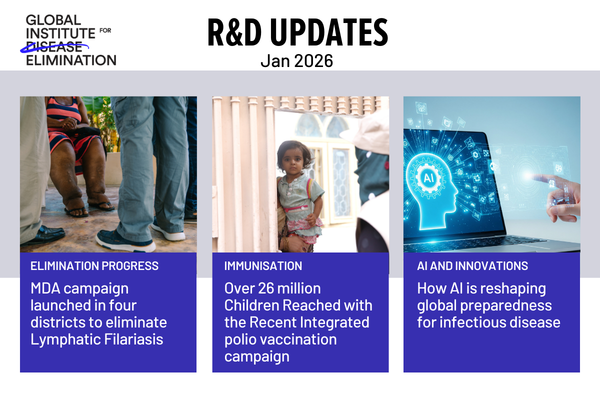
How AI is reshaping global preparedness for infectious disease – Link
Gates and OpenAI Team up to pilot AI solutions to African healthcare problems – Link
Drug resistance
Treatment failure and post-artesunate delayed haemolysis in a returned traveller from Uganda with partially drug-resistant severe plasmodium falciparum malaria – Link
Immunisation
Over 26 million Children Reached with the Recent Integrated polio vaccination campaign – Link
The Impact of integration: Vaccinating 100M+ children in Nigeria – Link
Rotary funds WHO to support Pakistan in protecting 27 million children against polio in high-risk districts – Link
Barriers and facilitators to implementing post-validation surveillance of lymphatic filariasis in Pacific Island countries and territories: A conceptual framework developed from qualitative data – Link
Elimination progress
How can technology accelerate Costa Rica’s path to malaria elimination? – Link
World NTD Day: Together, we’re ending neglected tropical diseases – Link
Researchers are getting closer to outsmarting the world’s deadliest parasite – Link
MDA campaign launched in four districts to eliminate Lymphatic Filariasis – Link
Eliminating human African trypanosomiasis: lessons from Kenya – Link
Making progress on global health will need high-quality evidence – Link
Climate and Health
Projected impacts of climate change on malaria in Africa – Link
How Rwanda is preparing its health system for the climate crisis – Link
Climatic and governance determinants of malaria transmission in Rivers State, Nigeria – Link
Other
GSK to support the END Fund in drive to eliminate neglected tropical diseases – Link
Fighting lymphatic filariasis in Madagascar: Lives transformed and hope restored – Link
Why India still carries the heaviest burden of neglected tropical diseases – Link
Communities unite to address stigma and discrimination affecting people with neglected tropical diseases – Link
Neglected tropical diseases: the need for an integrated approach to achieve the 2030 roadmap – Link
Ending neglected diseases requires partners willing to go where markets won’t – Link
World Neglected Tropical Diseases Day 2026: “These diseases are not just numbers—they represent people and communities who must not be left behind.” – Link
Improving lives of people affected by lymphatic filariasis in Kenya – Link
Incorporating lived experience of neglected tropical diseases strengthens health research – Link
Confronting neglected tropical diseases: a moral and strategic imperative for global equity – Link
Alwaleed Philanthropies (Global) continues its long-standing commitment with US$15 million for global polio eradication efforts – Link
The importance of values in a community-based response to malaria in Santo Domingo, Dominican Republic: Results from a longitudinal, mixed-methods study – Link | Link to Paper
Towards an international research agenda for public health advocacy: Practice, preparedness and knowledge gaps – Link
Measuring co-design in global health research: methodological challenges and decolonial innovations – Link