Vector Control
- Perception on blackflies and community ownership of the “Slash-and-Clear” vector control intervention in onchocerciasis-endemic communities along Edo-Ondo border in Southern Nigeria – Link
Diagnostic testing and treatment
- Pyronaridine-artesunate for treating uncomplicated Plasmodium falciparum malaria – Link
- Comparison of six weeks doxycycline versus six weeks rifampicin or three weeks of the combination of doxycycline plus rifampicin in the treatment of onchocerciasis: a randomized, placebo-controlled, double-blind, phase 2 trial – Link
- Diagnostic challenges of histidine-rich protein 2-based rapid diagnostic tests due to pfhrp2 and pfhrp3 gene deletions in asymptomatic malaria in Tanzania – Link
Data
- Advanced machine learning approaches for predicting Neglected Tropical Disease co-endemicity in Kenya: A focus on soil-transmitted helminths, schistosomiasis, and lymphatic filariasis – Link
- Spatio-temporal analysis and geostatistical modelling of onchocerciasis prevalence in Nigeria to support elimination efforts – Link
- No time to wait: A regional model for inter-epidemic vector-borne disease preparedness in the Caribbean – Link
- Spatio-temporal analysis and geostatistical modelling of onchocerciasis prevalence in Nigeria to support elimination efforts – Link
- Modelling of onchocerciasis-associated skin and ocular disease and the impact of ivermectin treatment – Link
AI and Innovations
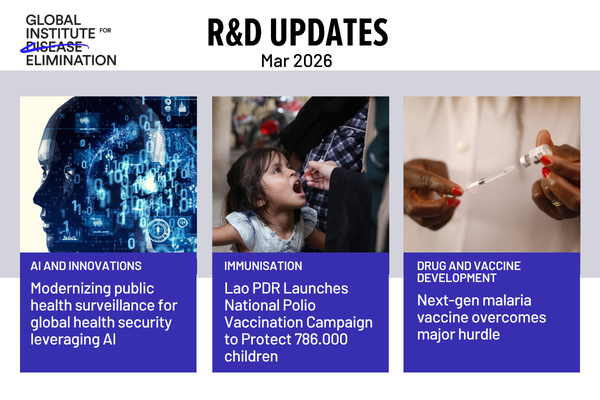
- Modernizing public health surveillance for global health security leveraging AI – Link
- MMV aims to tackle some tough malaria challenges with three new AI projects in drug discovery and development – Link
Drug and vaccine development
- Strengthening capacity for drug discovery and development in sub-Saharan Africa – Link
- Next-gen malaria vaccine overcomes major hurdle – Link
- ARK1 protein identified as malaria drug target – Link
Drug resistance
- Mosquitoes carrying malaria are evolving more quickly than insecticides can kill them – researchers pinpoint how – Link
- Malaria-transmitting mosquitoes in South America evolving to evade insecticides – Link | Link to Paper
Immunisation
- Angola launches national campaign to vaccinate more than 9 million children against polio – Link
- Lao PDR Launches National Polio Vaccination Campaign to Protect 786.000 children – Link
- Malaria vaccination reduces hospitalisations, deaths of children in northwestern Nigeria – Link
Surveillance
- Border region surveillance of malaria drug resistance, Northern Burundi, 2023–2024 – Link
- Targeted genomic surveillance unveils genetic variations linked to regional malaria drug resistance dynamics in India – Link
Elimination progress
- MHMS, Japan, and WHO bring malaria elimination closer to reality – Link
- Niger: the first human onchocerciasis-endemic country in Africa to achieve elimination of infection transmission – Link
- Billions of dollars, decades of progress spent eliminating devastating diseases may be lost with undoing of USAID – Link
- Nepal’s push to eliminate lymphatic filariasis by 2030 – Link
- The Institution-based Network on China–Africa Cooperation for Malaria Elimination: fostering a transcontinental hub for strengthening China–Africa cooperation on malaria control and elimination efforts – Link
Outbreak
- Women are leading polio outbreak response efforts across Africa – Link
Climate and Health
- How climate change is fueling disease outbreaks – Link
- Researchers launch new climate health projects with Wellcome support – Link
- Climate shocks, not just warming, threaten malaria control efforts in Africa – Link
Other
- A revolution in market shaping will drive a new era of global health – Link
- Negating neglect: social scientific contributions on Neglected Tropical Diseases and global health – Link
- A review of emerging threats in malaria control: The role of anopheles stephensi in Nigeria’s urban malaria resurgence – Link
- Programmatic implications of the efficiency of uptake of Onchocerca volvulus microfilaria by Simulium sp. Vectors – Link
- Global strategy meets field expertise in control of skin neglected tropical diseases – Link
- The show must go on: the street theatre troupe tackling vaccine hesitancy in rural Pakistan – Link
- Onchocerca volvulus infection prevalence and intensity in Logo and Nyarambe Health Zones in Ituri, Democratic Republic of the Congo in 2010 and in 2021-2023: results of screening for clinical trials of moxidectin versus ivermectin – Link
- Mapping the local effectiveness of mass drug administration for malaria using transportability methods – Link
- Host macrophages/monocytes promote malaria transmission by modulating mosquito microbiota via SR-A-mediated phagocytosis – Link
- Noise and neglect: Social-media signals expose attention gaps for dengue, chikungunya, lymphatic filariasis and kala-azar in India’s vector-borne NTDs – Link
- Expression of specific var gene subtypes is differentially associated with severe malaria syndromes – Link
- LL-37 selectively targets Plasmodium-infected erythrocytes and exhibits antimalarial activity – Link
- High prevalence of bancroftian filariasis and comorbidities in the eastern coalfield regions of West Bengal, India following COVID-19 disruption – Link
- GLIDE, UAE University partner to advance infectious disease elimination research – Link
- Coverage and associated factors of inactivated polio vaccine uptake among children aged 12–23 months in Sub-Saharan Africa – Link
- Urban Malaria Transmission in Niamey, Niger: Species Diversity and Entomological Parameters of the Anopheles gambiae complex – Link
- Regional development goals can improve global health in an era of diminished multilateralism – Link
- The persistent gap in mass drug administration uptake among known microfilaria-positive individuals in India’s lymphatic filariasis elimination program: a call for strengthened follow-up strategies – Link
- When floods hit, the risk of malaria follows: how disaster systems can prepare better – Link
- Evaluating the impact of the ‘Four Pest-Free Villages’ program on mosquito-borne disease control in Zhejiang Province, China: a cross-sectional study on knowledge, attitudes, and practices – Link