14 Nov 2025 Roundup of articles and publications on the latest innovations in malaria, polio, lymphatic filariasis, and onchocerciasis
Vector Control
Effect of exposure to malaria messages on insecticide-treated net use among women and under-five children in Uganda: a propensity score matched analysis – Link
Evaluating a novel multi-species vector control tool for humanitarian crises: the efficacy of attractive targeted sugar baits among forcibly displaced populations in Northern Nigeria – Link
Diagnostic testing and treatment
Pharmacometric evaluation of sulfadoxine-pyrimethamine- amodiaquine and dihydroartemisinin-piperaquine seasonal malaria chemoprevention in northern Uganda – Link
Single-dose malaria treatment using four drugs achieves high cure rates in clinical trial – Link | Link to Paper
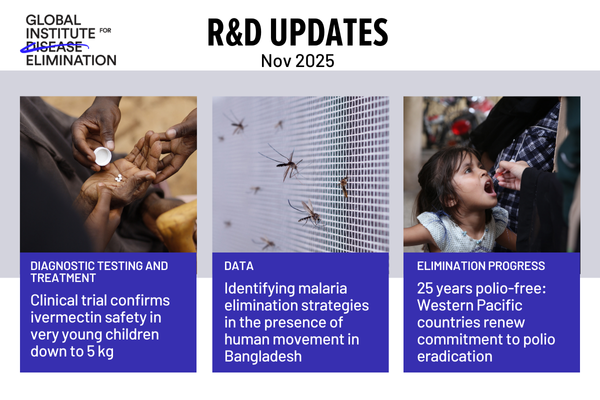
Clinical trial confirms ivermectin safety in very young children down to 5 kg – Link
A cross-sectional survey of Plasmodium falciparum and Plasmodium vivax in India using rapid diagnostic test and microscopy across 12 sites of varying transmission, 2023–2024 – Link
Data
Identifying malaria elimination strategies in the presence of human movement in Bangladesh – Link
Drug resistance
Managing insecticide resistance in malaria vectors in Africa: case studies from Cameroon, Côte d’Ivoire and Tanzania – Link
Surveillance
Detection of wild poliovirus type 1 in environmental sample in Germany – Link
Advancing wastewater and environmental surveillance in LMICs for public health response and SDG data gaps – Link
Elimination progress
25 years polio-free: Western Pacific countries renew commitment to polio eradication – Link
Preparing for the second lymphatic filariasis transmission survey in New Ireland province – Link
Statement of the Forty-third meeting of the Polio IHR Emergency Committee – Link
Outbreak
Assessing the potential for a malaria outbreak in Trinidad and Tobago due to migrant populations from Guyana and Venezuela for the period 2009–201 – Link